It has been over ninety degrees in Minnesota for days now. The dew point has been living in the tropics. The creeping Charlie in the yard is wilted by late morning, the asphalt has been soft since Sunday, and the dogs give up on the yard by nine in the morning. None of this fits the state’s reputation, which is cold: forty below, engine block heaters, wind chills that make the national news, the winter stories we hand to strangers in airports the way other people describe their surgeries. You can learn a lot about a place by which of its extremes the strangers ask about. Nobody has ever asked me about July.
But every summer there comes a stretch like this one, when the air is a wet wool blanket and the state becomes a swamp with Scandinavian manners, and we live through numbers that would make headlines if they happened somewhere with a different story attached. A place gets known for one of its extremes. The other one just gets lived in.
I have spent days inside this heat, and the heat has spent days handing me the summer of 1996.
In the summer of 1996 I was fifteen, and I spent as much of it as I could on a bicycle at the edge of my hometown. Hibbing sits on top of iron. The whole Range does; the towns up there exist because of what is underneath them, and Hibbing’s share was dug out of a pit on the north edge of town called the Hull Rust Mahoning, which the postcards call the Grand Canyon of the North without much exaggeration. An Australian friend who came with me to see a part of Minnesota he had yet to visit commented upon looking out over the pit, “It looks like Mordor from Lord of the Rings.” One of the largest open pit iron mines in the world: miles across, hundreds of feet down, terraced like an amphitheater built for an audience that never came. Tourists drive up to see it from an observation platform. The town itself mostly does not bother, the way you do not visit your own furnace.
Around the pit, the industry spent a century stacking what it did not want. The word for the first kind of material is overburden. It means everything that sits on top of the ore body: the glacial till, the gravel, the rock with no iron worth speaking of, all of it stripped off and hauled away so the shovels could reach what paid. The word for the second kind is low grade: rock with iron in it, but not enough, ore that would cost more to crush and ship than it would ever bring at the dock. Both went to the piles. The piles became hills. They have flat tops and straight sides and corners, geometry no glacier ever made, and they are the color of dried blood or a clay flowerpot depending on the light, and everyone in town calls them the dumps, because that is what they are.
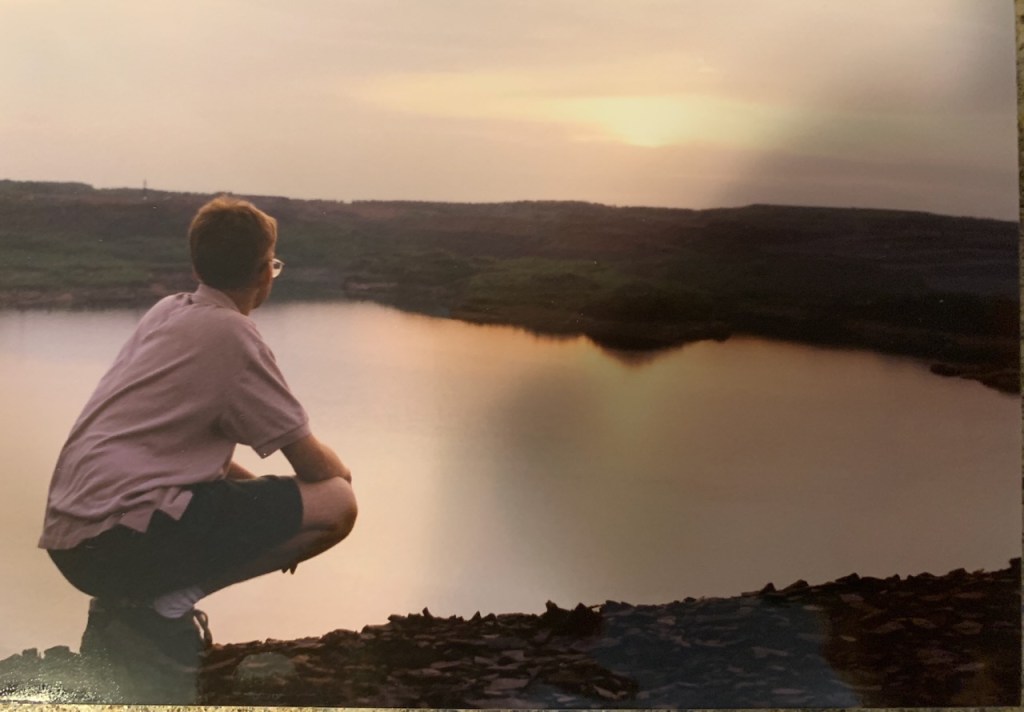
That summer I rode the edges. Out past where the streets gave up, along the fence lines and the haul roads, up whatever shoulder of waste rock a bike could be pushed up. I have carried that summer for thirty years as a hot one, and the records say I am wrong. The summer of 1996 ran mild: lows in the seventies, highs in the low eighties, the occasional push into the nineties, the kind of season this state considers fair payment for January. But memory files a summer the way strangers file a state, by its extremes, and the days it kept are the hot ones. By 1996 the pit itself had been going back to water for years. Where the pumps had gone quiet the groundwater had come up, and whole reaches of the floor lay under it, a lake at the bottom of a hole that was never meant to hold one. So on the few afternoons that did push ninety, it was the flat tops of the dumps that swam. Heat does that: it bends the air until you see water lying on rock where there is no water, and nobody calls that anything but July. Real water below, false water above, and a boy on a bike between them. I would ride until the sun finally lost interest, and come home with the bike rust colored, the chain rust colored, my socks rust colored, and stand at the sink and watch the water run orange into the drain. The dust was the ground itself, and it got into everything, and I never once noticed it while I was in it. You notice it at the sink.
It was a good summer, and nothing I am about to say takes that back.
The inside of my head that summer was loud. I do not have a better word for it, and as it turns out I never got one; the loudness is on the short list of things about me that thirty years have not changed. Thoughts came fast and in bunches, three and four abreast, each one towing the next. I could sit on a pile of rock built by machines the size of houses and run a hallway conversation from the previous school year through forty revisions of what I should have said. People called me a thinker, when they called me anything. Nobody called me a carer, but it was the truer word. Other people’s moods came home with me the way the dust came home on the bike, and I turned them over for days, and none of it, not one hour of it, looked to anyone like something that needed reporting.
The nights were the loudest part. There was a ceiling fan in my bedroom, and I would lie on top of the sheets under its slow circle with the thoughts going like traffic, replaying the day, pre-playing the next one, worrying a friend’s offhand comment down to the bare metal. I assumed that was what nights were. I assumed everyone lay there with the volume up and waited for sleep to shout it down. It did not occur to me to ask anybody, because you do not ask about the things you believe are universal, and nothing I carried had ever announced itself as unusual. It announced itself as me.
I do not remember hallucinating that summer. I am putting the sentence that way on purpose. I do not remember hallucinations, and I also would not have known to remember them. You keep what you have a name for, and I had no names yet, and would not for more than twenty years. Whatever moved at the edge of a fifteen year old’s vision in 1996 was a deerfly, or a shadow, or nothing, because those were the categories on hand. The record of that summer was kept by a boy who had no idea he was supposed to be keeping one.
So the question I keep circling in this heat is the one I cannot answer: how much of it was already there? The disorder I would eventually be handed a name for does not arrive like a piano falling. It seeps. And when I try to date the seep, I find that the Range got to the right framework long before psychiatry did, because the Range never asked whether rock had iron in it. Almost all of it has iron in it; that is what the place is. The question was always grade: whether a given ton held enough to be worth the cost of getting it out. The industry drew a line and called it cutoff grade, and the line moved year to year with prices and machinery. Below the line, the rock was waste. Above it, the rock was ore. The rock itself never changed. The line did.
At fifteen, whatever I carried graded out below every line then in use. A loud head was a personality. Racing thoughts were intelligence with the throttle stuck. Caring too much was being a good kid. Nobody assayed anything, and I do not blame them, because the instruments of the time said rock, and everyone was reading the instruments they had. There were no better ones pointed at the inside of a boy’s head. The boy least of all owned one.
There is no clean road from that boy to what I have to say next. I have spent a week looking for one, and the truthful report is that the two things connect the way the bugs move: at the periphery, sideways, gone the moment I turn to face them. So I will set the two things beside each other and let them be adjacent, because adjacent is how they came to me.
On Monday of last week, my psychiatrist added a line to my medication list: quetiapine, 200 milligrams, PRN. The letters stand for pro re nata, which the pharmacy softens into as needed, and which the Latin means more strangely and more beautifully than that: for the thing, as it arises. It is medication in the conditional mood. Not take this. If.
Quetiapine and I are old colleagues; it is already the workhorse of my evenings, and I have borrowed an extra dose from my own supply on hard days before. What is new is the line itself. A dose that exists for one specific thing, on standby, with the thing’s job description printed under it. The thing is the bugs.
They are small and black, insects of no particular species, the kind you would not look at twice in a house with a porch light. They walk along the edge of the kitchen counter, along the baseboard, across the arm of a chair, always at the border of my vision and never in the middle of it, and when I turn my head they are gone. Not scattered, the way real insects scatter. Gone. They do not survive being looked at. And they are not new, either. They are the usual bugs, the ones I have known for years, part of the standing inventory of my particular head. What was new this summer was the frequency. They had started getting past the medication more often than the medication is supposed to allow, and the clinical word for that is breakthrough, which is also a mining word, though nobody at the clinic gives any sign of hearing it that way. On the Range, you break through rock that was supposed to hold. In my case, the thing that was supposed to hold is a molecule, and the thing that comes through is small and black and takes a walk along the baseboard.
It was my therapist who sent me up the chain. We meet every other week, and when the bugs came up she did not flinch and she did not reach for alarm. What she said instead was smarter than either. She pointed out that I am, on most days, unusually aware of the state of my own head. I track mood and sleep and the speed of my thoughts the way other people track blood pressure, and so a report from me means something. A system that watches itself this closely does not file frivolous complaints. She said most of the time, and the qualifier is hers and mine both, because we have both seen the states whose first job is to eat the awareness. But this was not one of those. This was the aware version of me, noticing a change in the frequency of a known thing. Tell your psychiatrist, she said.
So I told him. And three days later there was a new line on the list and a bottle in the cabinet, and that was the entire event. No crisis. No adjustment to anything else. A pill that waits.
The bottle itself is unremarkable, which is part of what I keep noticing about it. Amber plastic, white cap, my name, and under the drug and the dose the pharmacy’s flat capitals: TAKE 1 TABLET BY MOUTH AS NEEDED. It sits in the cabinet beside the bottles that do not wait, the morning ones and the evening ones, the ones that empty on a rhythm and get refilled like a heartbeat. This one may still be nearly full in December. A prescription that hopes to be unnecessary. There is something almost courtly about it, a dose that stands off to the side of the day with its hands folded, waiting to be asked.
Here is the part I keep needing to say out loud, because even ten years ago I could not have said it: all of this is normal. It is normal for me to see things. It is normal for me to have thoughts that race. It is normal for me to have stretches of paranoia that I check against the facts and release like undersized fish. This is what a managed psychotic spectrum disorder is actually like from the inside, most of the time. Not an emergency. An inventory. The bugs used to disturb me badly; in the early years, every appearance felt like a door coming off its hinges somewhere in the back of the house. Now it is close to administrative. I notice, I note the date, I mention it at the next session, and if it keeps up, there is a dose for it, as needed, in the conditional mood.
Schizoaffective disorder has a reputation the way Minnesota has a reputation. The famous version is cinematic: the break, the voices, the locked ward, a mind coming apart in front of witnesses. That extreme exists. I have toured it, and I do not make light of it. But the other version is the one that fills the actual years, and it is daily, and it is boring, and it looks like this: racing thoughts at a kitchen table, suspicion inspected and released, insects that are not there taking a walk along a baseboard while a man with a dish towel decides whether they are worth a phone call. A condition gets known for one of its extremes. The other one just gets lived in.
You can get used to anything. I have decided that sentence is a triumph and an elegy at the same time, and that I am allowed to hold it as both.
Set the two summers side by side, then, the way the heat keeps setting them for me. Thirty years ago, a boy rode a bicycle along the rim of the biggest hole in the state with a head running loud enough to drown out the haul trucks, and nobody thought to measure any of it. Not a teacher, not a doctor, not the boy. There was nothing wrong with any of them. The instruments had not been invented yet, or had not been pointed at him, which amounts to the same thing. Last week, a middle aged man caught something small and black crossing the border of his vision a few too many times, said one sentence about it to one person, and inside of days the system around him had produced a considered, specific, conditional response. That is the distance. Everything I have built, and everything that has been built around me, fits between those two sentences.
And when I turn around to check the boy for early signs, to settle the question this heat keeps asking, the past behaves exactly like the bugs. Looked at straight on, it is gone. Memory kept the center of the frame: the pit, the shimmer, the orange water at the sink. The periphery it did not keep, and the periphery is where this thing has always lived. At the edge of town. At the edge of vision. At the edge of what counts. Sidelong, I can catch textures, the speed, the noise, the weight of other people’s moods carried home, and sidelong they look like evidence. Head on, they look like a kid. The honest answer to my own question is that the assay cannot be run. The samples were never taken, and the ground has since been thirty years reworked by every machine I have driven across it.
I do not know how much was showing at fifteen.
For most of a century, the Range’s answer to lean rock was the pile. Then a metallurgist at the University of Minnesota, a man named Davis, spent something like forty years working out how to make the lean rock pay, and after the high grade ore ran out, the industry went back. It ran old stone through new machinery. It hauled value out of hills that had been called waste by the same people who built them. There had been iron in that rock the whole time. There had just not been, yet, a way.
I want to be careful about what maps to what here, because the metaphor invites a mistake, and I have spent too much of this essay refusing the idea that illness is a gift to let it in the back door wearing a hard hat. The iron is not the disorder. The disorder is the geology, the way the ground happens to be arranged where I live. The iron is the person. The iron is whatever in a life turns out to be worth the work of getting at, and in my case the work took a diagnosis, a pharmacy, a therapist with a calendar, a psychiatrist with a prescription pad, and a slow retooling of my own attention that has taken most of my adult life. Overburden, it turns out, was the exact word all along. Everything piled on top had to be stripped and hauled and set aside before anyone could reach what paid.
The heat is supposed to hold through the weekend. The street out front has been swimming since noon. The bottle in the cabinet is a week old and nearly full, and with any luck it will stay nearly full, because as needed cuts both ways: some weeks the thing is not born. Somewhere north of here the pit is still there, and the dumps are still there, including the piles nobody has gone back for yet.
A boy rode home thirty years ago, on one of the hot days or one of the mild ones, with his head at full volume and the ground of the dumps all over his bike, and nobody anywhere had a name for what he was hauling. The man he turned into wipes down a counter where nothing was, notes the date, and goes to bed. Same rock. Better instruments. The iron was always in it.

 Quiet Mind, Loud Brain
Leave a comment